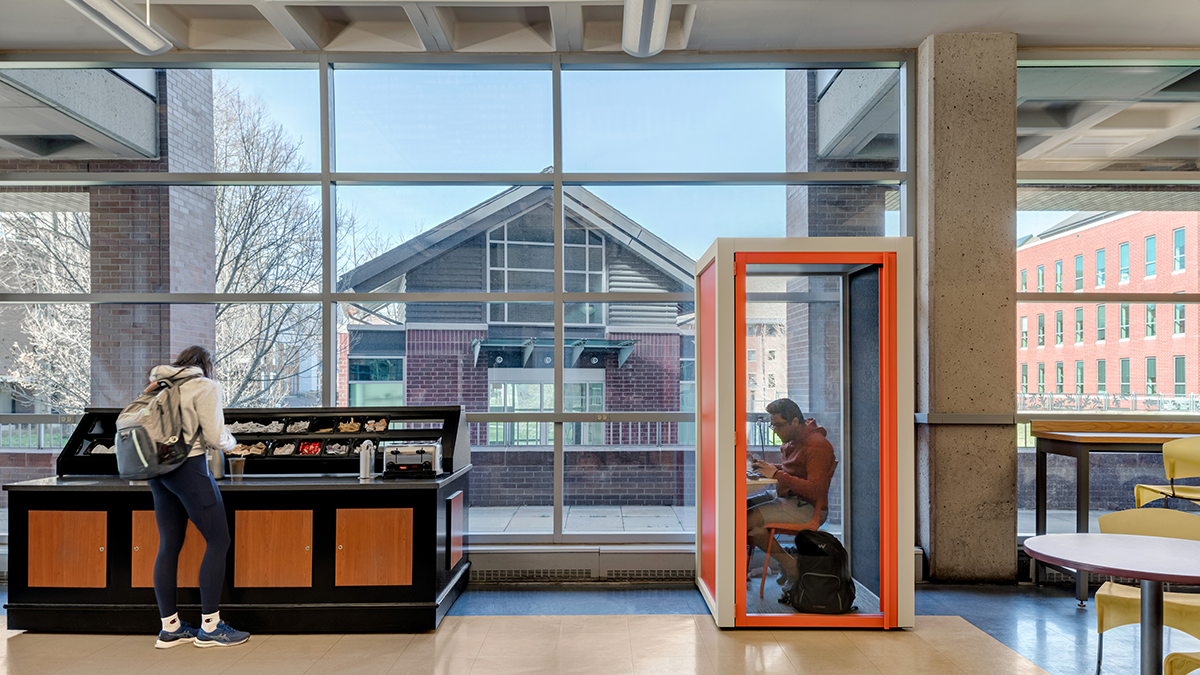
Privacy pods are a staple of modern study spaces. Find out how they help meet the different needs of college students nationwide.
Privacy pods are freestanding booths that give students on-demand access to private space without requiring new construction. Often called seating pods, study pods, or pod cubicles, they've become a staple of modern campus design to support the diverse ways students learn, connect, and recharge across higher education environments.
Campus study spaces have shifted from closed-off rooms and library carrels toward collaborative, open layouts. But students still want social connection and on-demand access to quiet, private space. WiggleRoom® Pods give colleges and universities an easy way to deliver both without reworking an entire floor plan.
Why Privacy Pods Are Reshaping Campus Design
Nearly half of U.S. college students say they prefer a mix of in-person and remote classes, and many want to attend on campus regardless of format. Privacy pods meet that demand inside buildings and layouts that already exist, supporting:
- Focused, distraction-free study
- Confidential personal and professional conversations
- Hybrid and virtual learning participation
- Collaborative group work in shared spaces
Because pods are freestanding, they can install in a matter of hours with minimal disruption.
Four Ways Students Are Using Privacy Pods on Campus
A Place to Land for Commuter Students
The majority of U.S. college students commute to campus and spend long stretches without access to private space. Multi-user privacy pods give commuter students places to regroup or meet with classmates between classes. At the University of Connecticut, colorful WiggleRoom® Pods appear throughout hallways, cafeterias, and common spaces, giving students a place to land wherever their day takes them.
Quiet Focus in Busy Libraries
As libraries evolve into hubs for collaboration and technology, truly quiet space is harder to find. Single-user WiggleRoom® Pods offer an acoustic advantage over traditional study carrels, reducing ambient noise by up to 30 decibels through sealed doors and sound-absorbing panels, suited for focused studying and test preparation.

Private Spaces for Personal and Professional Needs
Privacy on campus isn't just about studying. Students rely on privacy pods for virtual counseling, sensitive family conversations, and interviews for internships and jobs.
With most employers now interviewing virtually, students need professional, private spaces that fit into the rhythm of a day on campus. A WiggleRoom® Pod solves that on the spot. A student can step in, settle against a clean backdrop, and be ready to go, fitting an interview between classes instead of trekking back to a dorm room to find privacy. Faculty use the same pods to interview prospective colleagues, with sound-absorbing panels helping keep virtual meetings free of echo and background noise.
As more students seek mental health support, pods also offer a private space for telehealth appointments or simply a quiet moment between classes.

Spaces for Learning Together
When WiggleRoom® Pods first launched, higher education leaders kept asking some version of the same question: “Can you make this for two people? Or four? Or six?”
That demand helped lead to the WiggleRoom® Super Structure, bringing the enclosed privacy of a pod to a larger footprint for shared use. Available from 6' by 6' to 10' by 10' with open, closed, or louvered ceiling options, WiggleRoom® Super Structures give students flexible space to join virtual classes, collaborate on group projects, or meet with faculty.
At St. Francis College in Brooklyn, WiggleRoom® Super Structures with louvered ceilings dampen noise while still letting natural light through. These “rooms within rooms” create enclosed spaces inside libraries and student commons without permanent construction. They're portable, allowing campuses to reconfigure layouts as programs evolve or buildings change use.

Designed for Students, Built for Flexibility
As learning environments change, privacy pods give institutions a versatile, future-ready way to support focus, collaboration, well-being, and professional development in adaptable, on-demand spaces. WiggleRoom® Pods and WiggleRoom® Super Structures are also approved for use as Certified Autism Resource spaces and backed by a ten-year warranty.
Frequently Asked Questions
How are privacy pods used on college campuses?
Privacy pods give students on-demand access to private space for focused study, confidential conversations, virtual classes and interviews, and small-group collaboration, without the cost or disruption of new construction.
How much noise do privacy pods block out?
Single-user WiggleRoom® Pods reduce ambient noise by up to 30 decibels through sealed doors and sound-absorbing panels, offering an acoustic advantage over traditional study carrels.
Are privacy pods a permanent construction solution?
No. Privacy pods are freestanding and modular, so they install without major infrastructure disruption and can be reconfigured or relocated as campus needs change.
Do privacy pods support accessibility and inclusive design?
Yes. WiggleRoom® Pods and WiggleRoom® Super Structures are approved for use as Certified Autism Resource spaces and backed by a ten-year warranty.
Spaces That Move With Your Campus
As learning environments evolve, privacy pods give higher education institutions a future-ready way to support students wherever they need focus, privacy, or connection. Explore how WiggleRoom® Pods and WiggleRoom® Super Structures can support your campus, wherever learning happens.
Make Room for Better Ideas
Subscribe for insights on creating adaptable spaces that support how people focus, connect, and collaborate.
Contributing Authors
